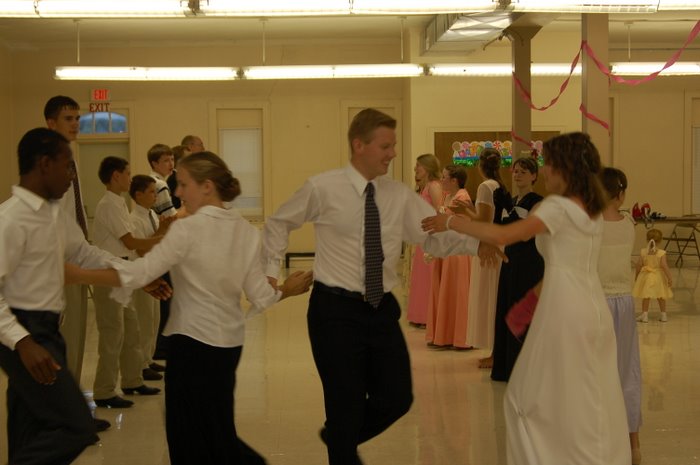
Dance music is hard to get right. Before our balls my sister and I have a lot of work to do. The music needs to be the right speed for each dance, provide a solid beat, give the right mood, and let the dancers get through the dance several times. Here's a few useful doo-dads.
I usually splice and loop the songs using GoldWave Editor. Sometimes I get carried away and make them too long, and sometimes I go crazy listening to the same phrase over and over again, trying to cut it in the right spot.
Beats-per-minute counter This thing could be real useful if you want to tack metronome beats on to the beginning of a song (if it doesn't have an introduction) or just to give you an idea of speed.
A definite recommendation of this CD. The songs are at nice dancing speeds and the beat is always laid down nicely. Some of the songs are a bit short, but that's what I use GoldWave for.
Tuesday, May 20, 2008


Tuesday, May 13, 2008
The Cavalier
According to a 19th century dance manual, a gentleman ought not play cavalier to two ladies. Don't worry, the guys don't ask two girls to dance, but a lot of the figures involve one gentleman and his partner and friend.
Oh, and the swings go by fast. Just enough time to get around once. This'll keep you on your toes.
A duple minor improper contra
A1
1-8: 1st gent (and two ladies) perform a Dunstable Round.
9-16: Second gentleman (and both ladies) circle perform a Dunstable Round
A2
17-24: Right allemande your partner (it will be appropriate to keep your arms closer to your side, rather than at eye level as is often practiced in the Virginia Reel)
25-32: Left allemande your partner
B1
33-36: 1st gentleman swing friend once around
37-40: 1st gentleman swing partner once
41-44: 2nd gentleman swing friend
45-48: 2nd gentleman swing partner
B2
49-56: 1st gentleman (and both ladies) in a Cavalier's Promenade
57-60: 2nd gentleman (and both ladies) in a Cavalier's Promenade
61-64: 2s arch and 1s join hands and go under.
Oh, and the swings go by fast. Just enough time to get around once. This'll keep you on your toes.
A duple minor improper contra
A1
1-8: 1st gent (and two ladies) perform a Dunstable Round.
9-16: Second gentleman (and both ladies) circle perform a Dunstable Round
A2
17-24: Right allemande your partner (it will be appropriate to keep your arms closer to your side, rather than at eye level as is often practiced in the Virginia Reel)
25-32: Left allemande your partner
B1
33-36: 1st gentleman swing friend once around
37-40: 1st gentleman swing partner once
41-44: 2nd gentleman swing friend
45-48: 2nd gentleman swing partner
B2
49-56: 1st gentleman (and both ladies) in a Cavalier's Promenade
57-60: 2nd gentleman (and both ladies) in a Cavalier's Promenade
61-64: 2s arch and 1s join hands and go under.
Terms for the dance
Dunstable Round-- circle--8 counts-- A circle with 3 people, one gentleman and both ladies in a duple minor set. To the left unless otherwise specified.
Allemande-- a turn--8 counts-- In traditional contra dancing, a right allemande would be performed by two people joining right hands and walking around each other in eight counts (a left allemande would be to join left hands, obviously). If the allemande is a move performed by a lady and a gent, a shake-hand hold may be used.
Swing-- A turn-- 4 counts (often twice in 8 counts)-- Two dancers stand side by side facing in opposite directions, they then hold each other while moving forwards; the result is that they move together in a tight circle. Stand beside your partner right shoulder to right shoulder, take half a step back, and then put your right feet in so the feet are adjacent. To swing you simply walk round keeping each foot on its circle, taking your weight on the inner foot, and using the outer foot to push you round like working a scooter. Remember to pick the inside foot up to move it round the circle. The standard hold is a Ballroom hold: the man puts his right hand in the middle of her back (and this arm does all the work; she rests her left hand on his right shoulder, and they hold the other hands loosely out to the side.
Cavelier's Promenade--Floor movement--8 counts-- One gent joins his right hand to his partner's left, and his left to his friend's right. They go down the set for four counts, facing the other gent in the set and walk back up for four counts in the same manner.
Arch-- partner/friend move-- 4 counts-- Simply join hands with your partner or friend to form an arch that other couples can pass under.
All terms used should be found here.
Monday, October 29, 2007
Spanish Waltz
This is not an original dance. This is a well-known traditional dance in an improper circle formation (dances like these are called Spanish Circle dances)
Double Circle dance--improper formation. Set up with gents on the inside of the circle, facing their ladies on the outside. Call a hands four. The first gent should switch with his partner so that the gents' left arms are both inside the minor set. (Thus ladies' rights to the inside) When you assume ballroom position your arms will point inside the set and the direction you will travel.)
Measures: Three counts per measure of course!
1-2: Balance with your partner holding right hands (six counts)
3-4: Right hand turn your partner (lady under the gent's arm) Turn to face your friend (six counts)
5-6: Balance with your friend (holding right hands) (six counts)
7-8: Right hand turn your friend. Turn to face your partner (six counts)
9-10: Balance your partner (right hands) six counts)
11-12: Right hand turn your partner. Face your friend (six counts)
13-14: Balance your friend. (six counts)
15-16: Right hand turn your friend (six counts)
You should be back where you started from here
17-20: Star right with set (putting right hands into the center travel clockwise) (12 counts)
21-24: Star left (putting left hands in the center travel counter-clockwise) (12 counts)
Once again, you should have returned to your starting position
25-32: Waltz to the next set past the other couple in the set. Inside lady and partner dance inside around the other couple and outside lady and partner dance outside the other couple to progress. (the gents backs ought to be to each other, this ensures that, if there is a collision, the gents will be the ones to get hurt)-- (8 measures, 24 counts)
The dance begins again with everybody in their new sets.
The terms used in the dance with counting adjusted for three/four time are below.
Balance (your partner or friend) -- partner/friend move--6 counts--2 measures-- The couple faces each other with right hands joined, steps toward your partner with your right foot, on the second beat bringing left foot beside your right foot and lift your heels off the floor slightly (stand on the balls of your feet). On the third beat lower your heels. Repeat this backwards: step back on your right foot, bring your left foot beside your right, lift your heels slightly, and come back down on the third beat.
Right Hand Turn -- partner/friend move--6 counts--2 measures-- The couple holds right hands, and walk towards each other. The gent raises his arm and the lady passes under their joined hands to face back into the set.
Stars--A minor set move-- 12 counts--4 measures- Stars are turns for four people. In your minor set, you reach into the center with one arm (a right arm for a right star, a left arm for a left star) and hold hands, then walk in the direction you're facing. In general people use a sort of up-down step as in the balance earlier in the dance. There are many ways to hold hands in the center. Our favorite way is to have each person hold the wrist of the person ahead of them-- this is often called a Wagon Wheel hold. Another way is simply to "stack" all the hands in the center. A third way is to have the gents hold hands, and ladies hold hands on top of them.
For further terms, consult our dance terms page.
Double Circle dance--improper formation. Set up with gents on the inside of the circle, facing their ladies on the outside. Call a hands four. The first gent should switch with his partner so that the gents' left arms are both inside the minor set. (Thus ladies' rights to the inside) When you assume ballroom position your arms will point inside the set and the direction you will travel.)
Measures: Three counts per measure of course!
1-2: Balance with your partner holding right hands (six counts)
3-4: Right hand turn your partner (lady under the gent's arm) Turn to face your friend (six counts)
5-6: Balance with your friend (holding right hands) (six counts)
7-8: Right hand turn your friend. Turn to face your partner (six counts)
9-10: Balance your partner (right hands) six counts)
11-12: Right hand turn your partner. Face your friend (six counts)
13-14: Balance your friend. (six counts)
15-16: Right hand turn your friend (six counts)
You should be back where you started from here
17-20: Star right with set (putting right hands into the center travel clockwise) (12 counts)
21-24: Star left (putting left hands in the center travel counter-clockwise) (12 counts)
Once again, you should have returned to your starting position
25-32: Waltz to the next set past the other couple in the set. Inside lady and partner dance inside around the other couple and outside lady and partner dance outside the other couple to progress. (the gents backs ought to be to each other, this ensures that, if there is a collision, the gents will be the ones to get hurt)-- (8 measures, 24 counts)
The dance begins again with everybody in their new sets.
The terms used in the dance with counting adjusted for three/four time are below.
Balance (your partner or friend) -- partner/friend move--6 counts--2 measures-- The couple faces each other with right hands joined, steps toward your partner with your right foot, on the second beat bringing left foot beside your right foot and lift your heels off the floor slightly (stand on the balls of your feet). On the third beat lower your heels. Repeat this backwards: step back on your right foot, bring your left foot beside your right, lift your heels slightly, and come back down on the third beat.
Right Hand Turn -- partner/friend move--6 counts--2 measures-- The couple holds right hands, and walk towards each other. The gent raises his arm and the lady passes under their joined hands to face back into the set.
Stars--A minor set move-- 12 counts--4 measures- Stars are turns for four people. In your minor set, you reach into the center with one arm (a right arm for a right star, a left arm for a left star) and hold hands, then walk in the direction you're facing. In general people use a sort of up-down step as in the balance earlier in the dance. There are many ways to hold hands in the center. Our favorite way is to have each person hold the wrist of the person ahead of them-- this is often called a Wagon Wheel hold. Another way is simply to "stack" all the hands in the center. A third way is to have the gents hold hands, and ladies hold hands on top of them.
For further terms, consult our dance terms page.
Friday, April 20, 2007
Two person figures
Figures performed by two people. All of these instructions are found in the dance terms post, but for the sake of being somewhat organized we have divided them up into categories.
Allemande-- a turn--8 counts-- In traditional contra dancing, a right allemande would be performed by two people joining right hands and walking around each other in eight counts (a left allemande would be to join left hands, obviously). Hence, a half-allemande takes 4 counts. If the allemande is a move performed by a lady and a gent, a shake-hand hold may be used. If the allemande is between two ladies or two gents, a pigeon grip is often used. --Other ways to do it are to hold each other at the elbow (we like to call this the "buffalo wing grip", but we are crazy) or just above the elbow.
Arch-- partner/friend move-- Unspecified count structure-- Simply join hands with your partner or friend to form an arch that other couples can pass under.
Balance (your partner or friend) -- partner/friend move--4 counts-- The couple faces each other with both hands joined (less commonly with one hand joined) and takes two steps toward each other, and then two steps apart.
Box the Gnat--a turn--4 counts--A couple meet offering right hands, they change places with the woman going under their joint raised arms, and turn to face each other still holding right hands. This means that they swap positions, and end up facing back the way they came.
Swat the Flea is a less common variant, where you use left hands instead of right.
California Twirl --a turn-- 4 counts-- Starting with a couple facing in the same direction (or each other) holding inside hands (man's right, woman's left) she turns left and moves into his place under their raised hands while he moves a step forward and then turns right and moves into her place. The lady does most of the "work" in this move. --Also referred to as a California Turn.
Chasse-- floor movement-- Unspecified count structure-- A fancy French word for what is essentially a form of skipping. Join hands with your partner and in a galloping fashion go where directed during that particular count structure.
Do-Si-Do (also Back to Back or Dos-a-do)--two person move--8 counts--(this figure returns you to your starting position)Commonly performed with your partner. Face the other person and pass right shoulders, pause and fall back to where you started, passing left shoulders. It should be noted that you continue to face the same direction the entire time. Some gents like to set their arms perpendicular to the ground on top of each other in front of them... (Indian style). Ladies often hold their skirts. (depending on the length of your skirt, this may be highly practical)
Honour--a still-standing move-- 4 counts (during a dance)-- You don't actually move on this one! Facing your partner or friend, the ladies curtsey and the gents bow. You've seen this done before many different ways-- pick a way you like. This is also commonly done at the beginning and ends of dances, often to no particular count structure. It would be appropriate during the musical introduction to the dance.
Kick Balance--Partner/friend--4 counts--Join right hands with your partner, step forward on your right foot, kick your left foot across your right, step back on your left foot and kick your right across your left.
Promenade--partner/friend move--Count structure specific to the dance--As a couple, with the lady on the right (at least properly, although we may ask you to do it wrong, in which case you can simply hold hands), the couple walks where the caller directs. There are several different handholds. In one method right hands are joined, and left hands are joined, and both are kept in front of the dancer's body, with the right hands on top. This is called the skaters promenade.
See Saw (left shoulder do-si-do) --two person--8 counts--Instead of starting the do-si-do with the right shoulder, the dancer starts with the left shoulder. (Two dancers begin facing each other, move so as to pass left shoulders, then back-to-back, then right shoulders, ending where they began.
Swat the Flea--a turn--4 counts--A couple meet offering left hands, they change places with the woman going under their joint raised arms, and turn to face each other still holding left hands. This means that they swap positions, and end up facing back the way they came.
Swing-- A turn-- 4 counts (often twice in 8 counts)-- Two dancers stand side by side facing in opposite directions, they then hold each other while moving forwards; the result is that they move together in a tight circle, and if they know what they are doing they can move rapidly and smoothly.
The simplest instruction is to stand beside your partner right shoulder to right shoulder, take half a step back, and then put your right feet in so the feet are adjacent. To swing you simply walk round keeping each foot on its circle, taking your weight on the inner foot, and using the outer foot to push you round like working a scooter. Remember to pick the inside foot up to move it round the circle - some people tend to keep their inner foot nailed to the ground.
The standard hold is a Ballroom hold: the man puts his right hand in the middle of her back (and this arm does all the work; she rests her left hand on his right shoulder, and they hold the other hands loosely out to the side.
--Other holds are: a cross-hands hold: you hold right hand in right, and left in left (conventionally right hands on top), and skip round in a much wider circle, or holding left hands as before, but putting your right hand on your partner's right shoulder with my right arm held straight (This arms-length hold means they can swing more as one unit). -- This is a lot of information for a simple move; it's not really that hard.
Allemande-- a turn--8 counts-- In traditional contra dancing, a right allemande would be performed by two people joining right hands and walking around each other in eight counts (a left allemande would be to join left hands, obviously). Hence, a half-allemande takes 4 counts. If the allemande is a move performed by a lady and a gent, a shake-hand hold may be used. If the allemande is between two ladies or two gents, a pigeon grip is often used. --Other ways to do it are to hold each other at the elbow (we like to call this the "buffalo wing grip", but we are crazy) or just above the elbow.
Arch-- partner/friend move-- Unspecified count structure-- Simply join hands with your partner or friend to form an arch that other couples can pass under.
Balance (your partner or friend) -- partner/friend move--4 counts-- The couple faces each other with both hands joined (less commonly with one hand joined) and takes two steps toward each other, and then two steps apart.
Box the Gnat--a turn--4 counts--A couple meet offering right hands, they change places with the woman going under their joint raised arms, and turn to face each other still holding right hands. This means that they swap positions, and end up facing back the way they came.
Swat the Flea is a less common variant, where you use left hands instead of right.
California Twirl --a turn-- 4 counts-- Starting with a couple facing in the same direction (or each other) holding inside hands (man's right, woman's left) she turns left and moves into his place under their raised hands while he moves a step forward and then turns right and moves into her place. The lady does most of the "work" in this move. --Also referred to as a California Turn.
Chasse-- floor movement-- Unspecified count structure-- A fancy French word for what is essentially a form of skipping. Join hands with your partner and in a galloping fashion go where directed during that particular count structure.
Do-Si-Do (also Back to Back or Dos-a-do)--two person move--8 counts--(this figure returns you to your starting position)Commonly performed with your partner. Face the other person and pass right shoulders, pause and fall back to where you started, passing left shoulders. It should be noted that you continue to face the same direction the entire time. Some gents like to set their arms perpendicular to the ground on top of each other in front of them... (Indian style). Ladies often hold their skirts. (depending on the length of your skirt, this may be highly practical)
Honour--a still-standing move-- 4 counts (during a dance)-- You don't actually move on this one! Facing your partner or friend, the ladies curtsey and the gents bow. You've seen this done before many different ways-- pick a way you like. This is also commonly done at the beginning and ends of dances, often to no particular count structure. It would be appropriate during the musical introduction to the dance.
Kick Balance--Partner/friend--4 counts--Join right hands with your partner, step forward on your right foot, kick your left foot across your right, step back on your left foot and kick your right across your left.
Promenade--partner/friend move--Count structure specific to the dance--As a couple, with the lady on the right (at least properly, although we may ask you to do it wrong, in which case you can simply hold hands), the couple walks where the caller directs. There are several different handholds. In one method right hands are joined, and left hands are joined, and both are kept in front of the dancer's body, with the right hands on top. This is called the skaters promenade.
See Saw (left shoulder do-si-do) --two person--8 counts--Instead of starting the do-si-do with the right shoulder, the dancer starts with the left shoulder. (Two dancers begin facing each other, move so as to pass left shoulders, then back-to-back, then right shoulders, ending where they began.
Swat the Flea--a turn--4 counts--A couple meet offering left hands, they change places with the woman going under their joint raised arms, and turn to face each other still holding left hands. This means that they swap positions, and end up facing back the way they came.
Swing-- A turn-- 4 counts (often twice in 8 counts)-- Two dancers stand side by side facing in opposite directions, they then hold each other while moving forwards; the result is that they move together in a tight circle, and if they know what they are doing they can move rapidly and smoothly.
The simplest instruction is to stand beside your partner right shoulder to right shoulder, take half a step back, and then put your right feet in so the feet are adjacent. To swing you simply walk round keeping each foot on its circle, taking your weight on the inner foot, and using the outer foot to push you round like working a scooter. Remember to pick the inside foot up to move it round the circle - some people tend to keep their inner foot nailed to the ground.
The standard hold is a Ballroom hold: the man puts his right hand in the middle of her back (and this arm does all the work; she rests her left hand on his right shoulder, and they hold the other hands loosely out to the side.
--Other holds are: a cross-hands hold: you hold right hand in right, and left in left (conventionally right hands on top), and skip round in a much wider circle, or holding left hands as before, but putting your right hand on your partner's right shoulder with my right arm held straight (This arms-length hold means they can swing more as one unit). -- This is a lot of information for a simple move; it's not really that hard.
Minor set figures
This is a little bit of housekeeping, getting our terms organized. The following are figures involving the whole set.
Balance the Ring--a minor set move--four counts--The minor set joins hands in a circle, facing inward. Everyone takes two steps toward the center of the circle and two steps back.
Circle (minor set) --a minor set move--8 counts-- All dancers in the minor set join hands and circle in the direction given in the call. Left is more common than right, and if both are done, left will occur first.
Circle Hey-- a minor set move-- 16 counts-- In the minor set, face across center of hall, and pass right shoulders with your partner/friend/neighbor (the person across from you), then turn 90 degrees back into the set, and pass left shoulders with the other person, turn 90 degrees again, pass right shoulders with the first person you pass right shoulders with, then turn 90 degrees again and pass left shoulders with the first person you passed left shoulders with before. This is just like the right-and-left-through, without using hands.
Dixie Twirl --minor set move--(we use it in 8 counts)--In a line of four dancers, the center pair arches. The extreme right person leads through the arch (taking the one on their left along for the ride) while the left person walks to the right. This results in an inverted line now facing the other way.
Ladies Chain--A minor set move--full: 16 counts; half: 8 counts--Involves two facing couples, each with the lady on the right. The women cross over giving each other right hands, and do a left hand turn about three quarters with the opposite man to end up beside him where the other woman started from. The men can help, first by moving to their right so the women coming to them don't have so far to go, and then by swinging them round firmly in the left hand turn. The turn we use is a courtesy turn. The gent holds the lady's left hand in his and the lady puts her right hand on her waist allowing the gent to take her right in his and help her around as they turn as couple. What has just been described is a half ladies chain, to do a full the figure is repeated again and everyone ends in the same spot as when they began the figure.
Petronella Turn (also called just a "Petronella")--a minor set move--4 counts--Four dancers, equally spaced around a small ring (or square), move into the position of the dancer on their right in four steps while rotating (spinning) individually clockwise 3/4. This movement is adapted from the eponymous dance "Petronella," a traditional contra dance derived from a Scottish country dance of the same name. As an embellishment, you may add a "clap-clap" of hands on beats 3.5 and 4 of the 4-beat movement. It is Han's favorite move.
Right and Left Through-- a minor set move-- 16 counts-- This figure starts with two dancers facing another pair, frequently facing across the set to your partner, but sometimes facing up and down the set. Facing as directed you change places with the one you are facing giving right hands as you pass, then turn to your neighbour (90 degrees) and change places with them giving left hands, ending up holding left hands and both facing back in to the set (someone will have to turn; avoid twisting anyone's arm). A right and left is so frequently followed by a second that it is dangerous to describe it as such: usually what has been described is called `a half right and left through', and two in succession `a full right and left through'.
Stars--A minor set move-- 8 counts-- Stars are turns for (usually) four people. In your minor set, you reach into the center with one arm (a right arm for a right star, a left arm for a left star) and hold hands, then walk in a complete circle once. A right star genereally goes first, and is usually followed by a left star. There are many ways to hold hands in the center. Our favorite way is to have each person hold the wrist of the person ahead of them-- this is often called a Wagon Wheel hold. Another way is simply to "stack" all the hands in the center. A third way is to have the gents hold hands, and ladies hold hands on top of them. (In a proper...In an improper you can hold your corners hand) A fun move!
These terms taken from our dance terms page.
Balance the Ring--a minor set move--four counts--The minor set joins hands in a circle, facing inward. Everyone takes two steps toward the center of the circle and two steps back.
Circle (minor set) --a minor set move--8 counts-- All dancers in the minor set join hands and circle in the direction given in the call. Left is more common than right, and if both are done, left will occur first.
Circle Hey-- a minor set move-- 16 counts-- In the minor set, face across center of hall, and pass right shoulders with your partner/friend/neighbor (the person across from you), then turn 90 degrees back into the set, and pass left shoulders with the other person, turn 90 degrees again, pass right shoulders with the first person you pass right shoulders with, then turn 90 degrees again and pass left shoulders with the first person you passed left shoulders with before. This is just like the right-and-left-through, without using hands.
Dixie Twirl --minor set move--(we use it in 8 counts)--In a line of four dancers, the center pair arches. The extreme right person leads through the arch (taking the one on their left along for the ride) while the left person walks to the right. This results in an inverted line now facing the other way.
Ladies Chain--A minor set move--full: 16 counts; half: 8 counts--Involves two facing couples, each with the lady on the right. The women cross over giving each other right hands, and do a left hand turn about three quarters with the opposite man to end up beside him where the other woman started from. The men can help, first by moving to their right so the women coming to them don't have so far to go, and then by swinging them round firmly in the left hand turn. The turn we use is a courtesy turn. The gent holds the lady's left hand in his and the lady puts her right hand on her waist allowing the gent to take her right in his and help her around as they turn as couple. What has just been described is a half ladies chain, to do a full the figure is repeated again and everyone ends in the same spot as when they began the figure.
Petronella Turn (also called just a "Petronella")--a minor set move--4 counts--Four dancers, equally spaced around a small ring (or square), move into the position of the dancer on their right in four steps while rotating (spinning) individually clockwise 3/4. This movement is adapted from the eponymous dance "Petronella," a traditional contra dance derived from a Scottish country dance of the same name. As an embellishment, you may add a "clap-clap" of hands on beats 3.5 and 4 of the 4-beat movement. It is Han's favorite move.
Right and Left Through-- a minor set move-- 16 counts-- This figure starts with two dancers facing another pair, frequently facing across the set to your partner, but sometimes facing up and down the set. Facing as directed you change places with the one you are facing giving right hands as you pass, then turn to your neighbour (90 degrees) and change places with them giving left hands, ending up holding left hands and both facing back in to the set (someone will have to turn; avoid twisting anyone's arm). A right and left is so frequently followed by a second that it is dangerous to describe it as such: usually what has been described is called `a half right and left through', and two in succession `a full right and left through'.
Stars--A minor set move-- 8 counts-- Stars are turns for (usually) four people. In your minor set, you reach into the center with one arm (a right arm for a right star, a left arm for a left star) and hold hands, then walk in a complete circle once. A right star genereally goes first, and is usually followed by a left star. There are many ways to hold hands in the center. Our favorite way is to have each person hold the wrist of the person ahead of them-- this is often called a Wagon Wheel hold. Another way is simply to "stack" all the hands in the center. A third way is to have the gents hold hands, and ladies hold hands on top of them. (In a proper...In an improper you can hold your corners hand) A fun move!
These terms taken from our dance terms page.
Thursday, April 19, 2007
Lorisha's First Waltz
Dedicated to Lorisha who never gets to waltz, but is graceful enough to have one written for her.
Double Circle dance--improper formation. Set up with gents on the inside of the circle, facing their ladies on the outside. Call a hands four. One gents should switch with his partner so that the gents' left arms are both inside the minor set. (Thus ladies' rights to the inside) When you assume ballroom position your arms will point inside the set and the direction you will travel.
Measures: (This is a waltz, so clearly the measures are three counts each, right?)
1-2: Right hand turn (box-the-gnat) your partner and face back into the set (six counts)
3-4: Balance the ring. 1 measure in; 1 measure out (six counts)
5-6: Right hand turn your friend and face back into the set (six counts)
7-8: Balance the ring (six counts)
9-10: Right hand turn your partner and face back into the set (six counts)
11-12: Balance the ring (six counts)
13-14: Right hand turn your friend and face back in (six counts)
15-16: Balance the ring (six counts)
17-20: Ladies chain across (12 counts)
2 measures for ladies to change places; 2 measures for courtesy turn;
21-24: Ladies chain back (12 counts)
2 measures for ladies to change places again; 2 measures for second courtesy turn.
25-32: Waltz to the next set past the other couple in the set. Inside lady and partner dance inside around the other couple and outside lady and partner dance outside the other couple to progress. (8 measures, 24 counts)
Suggested music- Zan Mcleod: Highland Soul

Track 3: The Ash Grove
Terms for the dance: (with counts adjusted for 3/4 time)
Box the Gnat--a turn--6 counts--A couple meet offering right hands, they change places with the woman going under their joint raised arms, and turn to face each other still holding right hands. This means that they swap positions and end up facing the way they came.
Balance the Ring--a minor set move--6 counts--The minor set joins hands in a circle, facing inward. Everyone takes two steps toward the center of the circle, lifting their heels slightly on the second step (standing on the balls of their feet), putting them down on the third count (as a balance in the Spanish Waltz) and two steps back, on the second step lifting their heels and coming down on the third count
Ladies Chain--A minor set move--full, 24 counts; half, 12 counts--Involves two facing couples, each with the lady on the right. The women cross over giving each other right hands, and do a left hand turn about three quarters with the opposite man to end up beside him where the other woman started from. The turn we use is a courtesy turn. The gent holds the lady's left hand in his and the lady puts her right hand on her waist allowing the gent to take her right in his and help her around as they turn as couple. What has just been described is a half ladies chain, to do a full the figure is repeated again and everyone ends in the same spot as when they began the figure. Don't get ahead, 12 counts is far more than enough to perform all this!
Double Circle dance--improper formation. Set up with gents on the inside of the circle, facing their ladies on the outside. Call a hands four. One gents should switch with his partner so that the gents' left arms are both inside the minor set. (Thus ladies' rights to the inside) When you assume ballroom position your arms will point inside the set and the direction you will travel.
Measures: (This is a waltz, so clearly the measures are three counts each, right?)
1-2: Right hand turn (box-the-gnat) your partner and face back into the set (six counts)
3-4: Balance the ring. 1 measure in; 1 measure out (six counts)
5-6: Right hand turn your friend and face back into the set (six counts)
7-8: Balance the ring (six counts)
9-10: Right hand turn your partner and face back into the set (six counts)
11-12: Balance the ring (six counts)
13-14: Right hand turn your friend and face back in (six counts)
15-16: Balance the ring (six counts)
17-20: Ladies chain across (12 counts)
2 measures for ladies to change places; 2 measures for courtesy turn;
21-24: Ladies chain back (12 counts)
2 measures for ladies to change places again; 2 measures for second courtesy turn.
25-32: Waltz to the next set past the other couple in the set. Inside lady and partner dance inside around the other couple and outside lady and partner dance outside the other couple to progress. (8 measures, 24 counts)
Suggested music- Zan Mcleod: Highland Soul

Track 3: The Ash Grove
Terms for the dance: (with counts adjusted for 3/4 time)
Box the Gnat--a turn--6 counts--A couple meet offering right hands, they change places with the woman going under their joint raised arms, and turn to face each other still holding right hands. This means that they swap positions and end up facing the way they came.
Balance the Ring--a minor set move--6 counts--The minor set joins hands in a circle, facing inward. Everyone takes two steps toward the center of the circle, lifting their heels slightly on the second step (standing on the balls of their feet), putting them down on the third count (as a balance in the Spanish Waltz) and two steps back, on the second step lifting their heels and coming down on the third count
Ladies Chain--A minor set move--full, 24 counts; half, 12 counts--Involves two facing couples, each with the lady on the right. The women cross over giving each other right hands, and do a left hand turn about three quarters with the opposite man to end up beside him where the other woman started from. The turn we use is a courtesy turn. The gent holds the lady's left hand in his and the lady puts her right hand on her waist allowing the gent to take her right in his and help her around as they turn as couple. What has just been described is a half ladies chain, to do a full the figure is repeated again and everyone ends in the same spot as when they began the figure. Don't get ahead, 12 counts is far more than enough to perform all this!
Saturday, January 27, 2007
O man, learn to dance
I praise the dance, for it frees people
from the heaviness of matter and
binds the isolated to community.
I praise the dance, which demands everything:
health and a clear spirit and a buoyant soul.
Dance is a transformation of space, of time, of people,
who are in constant danger of
becoming all brain, will, or feeling.
Dancing demands a whole person,
one who is firmly anchored in the center of his life,
who is not obsessed by lust for people and things
and the demon of isolation in his own ego.
Dancing demands a freed person,
one who vibrates with the equipoise of all his powers.
I praise the dance.
O man, learn to dance,
or else the angels in Heaven
will not know what to do with you.
~ Saint Augustine of Hippo (attr.)
from the heaviness of matter and
binds the isolated to community.
I praise the dance, which demands everything:
health and a clear spirit and a buoyant soul.
Dance is a transformation of space, of time, of people,
who are in constant danger of
becoming all brain, will, or feeling.
Dancing demands a whole person,
one who is firmly anchored in the center of his life,
who is not obsessed by lust for people and things
and the demon of isolation in his own ego.
Dancing demands a freed person,
one who vibrates with the equipoise of all his powers.
I praise the dance.
O man, learn to dance,
or else the angels in Heaven
will not know what to do with you.
~ Saint Augustine of Hippo (attr.)
Monday, December 25, 2006
Karissa's Cowboy Reel
A Christmas present for all of you!
Karissa's Cowboy Reel
A major set proper contra, count structure optional; in the manner of the Virginia Reel. That is to say, the steps outlined are to be danced every time, in the order they are listed; but the caller my repeat them or add in other steps whenever or wherever he or she chooses.
Counts:
1-4: All kick balance with partner
5-8: All kick balance with partner
9-16: All do-si-do with partner
17-20: All box-the-gnat with partner
21-24: All box-the-gnat with partner
25-28: All swat-the-flea with partner
29-32: All swat-the-flea with partner
Head couple casts off, and travels outside the line to the bottom of the set-- the line follows. When they reach the bottom, the join left hands high, and use right hands to pull the rest of the couples through. That is: The head gent offers his right to the second lady, pulling her across to his side. The head leady offers her right to the second gent, pulling him across to her side. They repeat this with every couple.
Every couple (except the original heads) turn or twirl in any preferred manner to get back on the proper sides.
When all couples have gone under, the original head couple reels up the set backwards-- they offer left arms to each other and right arms to their friends.
When the head couple reaches the top, all other couples form arches, the heads skip under and down the line, and when they reach the bottom, the couple at the top becomes the new head couple and the dance starts over.
Terms for the dance:
Karissa's Cowboy Reel
A major set proper contra, count structure optional; in the manner of the Virginia Reel. That is to say, the steps outlined are to be danced every time, in the order they are listed; but the caller my repeat them or add in other steps whenever or wherever he or she chooses.
Counts:
1-4: All kick balance with partner
5-8: All kick balance with partner
9-16: All do-si-do with partner
17-20: All box-the-gnat with partner
21-24: All box-the-gnat with partner
25-28: All swat-the-flea with partner
29-32: All swat-the-flea with partner
Head couple casts off, and travels outside the line to the bottom of the set-- the line follows. When they reach the bottom, the join left hands high, and use right hands to pull the rest of the couples through. That is: The head gent offers his right to the second lady, pulling her across to his side. The head leady offers her right to the second gent, pulling him across to her side. They repeat this with every couple.
Every couple (except the original heads) turn or twirl in any preferred manner to get back on the proper sides.
When all couples have gone under, the original head couple reels up the set backwards-- they offer left arms to each other and right arms to their friends.
When the head couple reaches the top, all other couples form arches, the heads skip under and down the line, and when they reach the bottom, the couple at the top becomes the new head couple and the dance starts over.
Terms for the dance:
Kick Balance--Partner/friend--4 counts--Join right hands with your partner, step forward on your right foot, kick your left foot across your right, step back on your left foot and kick your right across your left.
Do-si-do--two person move--8 counts--(this figure returns you to your starting position)Commonly performed with your partner. Face the other person and pass right shoulders, pause and fall back to where you started, passing left shoulders. It should be noted that you continue to face the same direction the entire time.
Box the Gnat--a turn--4 counts--A couple meet offering right hands, they change places with the woman going under their joint raised arms, and turn to face each other still holding right hands. This means that they swap positions, and end up facing back the way they came.
Swat the Flea--a turn--4 counts--A couple meet offering left hands, they change places with the woman going under their joint raised arms, and turn to face each other still holding left hands.
All terms used can be found here.
Tuesday, October 31, 2006
Your Attention Please!
Dear Readers,
We have recently written quite a few contras, waltzes and other dances. Please vote on which one you'd like to see on the site next:
Noelle's Lucky Star (a four-couple-formation dance)
Lorisha's Waltz (A circle waltz)
Karissa's Cowboy Reel (A major set proper contra)
The Trinitarian Terpsichore (A triple minor proper contra)
Voting will take place until we get a sufficient amount of votes. :-)
We have recently written quite a few contras, waltzes and other dances. Please vote on which one you'd like to see on the site next:
Noelle's Lucky Star (a four-couple-formation dance)
Lorisha's Waltz (A circle waltz)
Karissa's Cowboy Reel (A major set proper contra)
The Trinitarian Terpsichore (A triple minor proper contra)
Voting will take place until we get a sufficient amount of votes. :-)
Tuesday, September 26, 2006
Hannah's Birthday Balance
Recently a dance-deserving friend of ours, Hannah Rot, had a birthday, and this is one of our gifts to her.
We are beginning to divide dance counts into correct contra divisions: A, A2, B, B2. These are to aid you in following the music. Each division is 16 counts of music and movement. They do not change how the dances are danced.
A duple minor improper contra
Division A
1-4: All honor friend
5-8: All honor partner
9-12: Balance the ring
13-16: Balance the ring
A2
17-24: Half ladies' chain with courtesy turn
25-28: Balance the ring
29-32: Balance the ring
Division B
33-40: Star, using handshake hold
41-48: Half ladies' chain with courtesy turn
B2
49-52: 1s (actives) turning down the set, 2s (inactives) turning up, each couple takes closest hands with each other (gent's right to lady's left) and the ones pass over the twos, thus progressing down the set
43-56: Gents holding their lady's hand high, ladies twirl once underneath, much like a twirl in a waltz
57-60: All balance into new minor set. That is to say, each couple holding hands (but not with the other couple), they take two steps forward, and two steps back
60-64: All side balance. If you have danced the Gay Gordons, you may recognize this. Still holding hands and facing up or down the set, each couple takes two sideways steps toward each other, and two away from each other.
Recommended Music: The Beauty of the North, Tracks 21, 22, 23-- Reel de Chicoutimi, Reel St. Jean, Reel Eboulement. These three elegant and cheerful tracks merge into one another for a longer time of dance and enjoyment.

Terms for the dance:
Honour--a still-standing move-- 4 counts (during a dance)-- You don't actually move on this one! Facing your partner or friend, the ladies curtsey and the gents bow. You've seen this done before many different ways-- pick a way you like.
Balance the Ring--a minor set move--four counts--The minor set joins hands in a circle, facing inward. Everyone takes two steps toward the center of the circle and two steps back.
Ladies Chain--A minor set move--full: 16 counts; half: 8 counts--Involves two facing couples, each with the lady on the right. The women cross over giving each other right hands, and do a left hand turn about three quarters with the opposite man to end up beside him where the other woman started from. The men can help, first by moving to their right so the women coming to them don't have so far to go, and then by swinging them round firmly in the left hand turn. The turn we use is a courtesy turn. The gent holds the lady's left hand in his and the lady puts her right hand on her waist allowing the gent to take her right in his and help her around as they turn as couple. What has just been described is a half ladies chain, to do a full the figure is repeated again and everyone ends in the same spot as when they began the figure.
Star--A minor set move-- 8 counts-- Stars are turns for (usually) four people. In your minor set, you reach into the center with one arm (a right arm for a right star, a left arm for a left star) and hold hands, then walk in a complete circle once. With the handshake hold the gents hold hands across the center of the minor set, and ladies hold hands on top of them. A fun move!
(all other terms left off this list are either defined in the dance description or can be found at the dance terms page).
We are beginning to divide dance counts into correct contra divisions: A, A2, B, B2. These are to aid you in following the music. Each division is 16 counts of music and movement. They do not change how the dances are danced.
A duple minor improper contra
Division A
1-4: All honor friend
5-8: All honor partner
9-12: Balance the ring
13-16: Balance the ring
A2
17-24: Half ladies' chain with courtesy turn
25-28: Balance the ring
29-32: Balance the ring
Division B
33-40: Star, using handshake hold
41-48: Half ladies' chain with courtesy turn
B2
49-52: 1s (actives) turning down the set, 2s (inactives) turning up, each couple takes closest hands with each other (gent's right to lady's left) and the ones pass over the twos, thus progressing down the set
43-56: Gents holding their lady's hand high, ladies twirl once underneath, much like a twirl in a waltz
57-60: All balance into new minor set. That is to say, each couple holding hands (but not with the other couple), they take two steps forward, and two steps back
60-64: All side balance. If you have danced the Gay Gordons, you may recognize this. Still holding hands and facing up or down the set, each couple takes two sideways steps toward each other, and two away from each other.
Recommended Music: The Beauty of the North, Tracks 21, 22, 23-- Reel de Chicoutimi, Reel St. Jean, Reel Eboulement. These three elegant and cheerful tracks merge into one another for a longer time of dance and enjoyment.
Terms for the dance:
Honour--a still-standing move-- 4 counts (during a dance)-- You don't actually move on this one! Facing your partner or friend, the ladies curtsey and the gents bow. You've seen this done before many different ways-- pick a way you like.
Balance the Ring--a minor set move--four counts--The minor set joins hands in a circle, facing inward. Everyone takes two steps toward the center of the circle and two steps back.
Ladies Chain--A minor set move--full: 16 counts; half: 8 counts--Involves two facing couples, each with the lady on the right. The women cross over giving each other right hands, and do a left hand turn about three quarters with the opposite man to end up beside him where the other woman started from. The men can help, first by moving to their right so the women coming to them don't have so far to go, and then by swinging them round firmly in the left hand turn. The turn we use is a courtesy turn. The gent holds the lady's left hand in his and the lady puts her right hand on her waist allowing the gent to take her right in his and help her around as they turn as couple. What has just been described is a half ladies chain, to do a full the figure is repeated again and everyone ends in the same spot as when they began the figure.
Star--A minor set move-- 8 counts-- Stars are turns for (usually) four people. In your minor set, you reach into the center with one arm (a right arm for a right star, a left arm for a left star) and hold hands, then walk in a complete circle once. With the handshake hold the gents hold hands across the center of the minor set, and ladies hold hands on top of them. A fun move!
(all other terms left off this list are either defined in the dance description or can be found at the dance terms page).
Monday, August 28, 2006
Gnatty's Tarantism
In honor of Naddy who deserved a dance, and just to use a great word. A tarantism is an uncontrollable urge to dance. Thanks to the anonymous person who brought the word to our attention.
A duple minor improper contra
A
1-4: 1s balance
5-8: 2s balance
9-12: 1s swing
13-16: 2s swing
A2
17-20: 1s box-the-gnat
21-24: 2s box-the-gnat
25-28: 1s swat-the-flea
29-32: 2s swat-the-flea
B
33-40: All do-si-do partner
41-48: All see-saw partner
B2
49-52: With right hands joined, balance your friend
53-56: Box-the-gnat with your friend
57-60: 2s arch and 1s join hands and chasse under
61-64: 1s cast around 2s to join the next set.
Recommended Music: Shakin' Down the Acorns, Track 6-- Devil's Dream/Flowers of Edinburgh/Drowsy Maggie. This song features the hammered dulcimer, which helps bring out the "gnat" idea, and it has continuous movement.

Terms for the dance:
-Balance (your partner or friend) -- partner/friend move--4 counts-- The couple faces each other with both hands joined (less commonly with one hand joined) and takes two steps toward each other, and then two steps apart. Balances may also be done in lines or circles.
-Swing-- partner/friend move-- 4 counts (often twice in 8 counts)-- Two dancers stand side by side facing in opposite directions, they then hold each other while moving forwards; the result is that they move together in a tight circle, and if they know what they are doing they can move rapidly and smoothly.The simplest instruction is to stand beside your partner right shoulder to right shoulder, take half a step back, and then put your right feet in so the feet are adjacent. To swing you simply walk round keeping each foot on its circle, taking your weight on the inner foot, and using the outer foot to push you round like working a scooter. Remember to pick the inside foot up to move it round the circle - some people tend to keep their inner foot nailed to the ground.The standard hold is a Ballroom hold: the man puts his right hand in the middle of her back (and this arm does all the work; she rests her left hand on his right shoulder, and they hold the other hands loosely out to the side. --for more holds visit the dance terms page
-Box the Gnat--a turn--4 counts--A couple meet offering right hands, they change places with the woman going under their joint raised arms, and turn to face each other still holding right hands. This means that they swap positions, and end up facing back the way they came.
-Swat the Flea--a turn--4 counts--A couple meet offering left hands, they change places with the woman going under their joint raised arms, and turn to face each other still holding left hands.
-Do-si-do (also Back to Back or Dos-a-do)--two person move--8 counts--(this figure returns you to your starting position)Commonly performed with your partner. Face the other person and pass right shoulders, pause and fall back to where you started, passing left shoulders. It should be noted that you continue to face the same direction the entire time. Some gents like to set their arms perpendicular to the ground on top of each other in front of them... (Indian style). Ladies often hold their skirts.
-See Saw (left shoulder do-si-do) --two person--8 counts--Instead of starting the do-si-do with the right shoulder, the dancer starts with the left shoulder. (Two dancers begin facing each other, move so as to pass left shoulders, then back-to-back, then right shoulders, ending where they began.
-Arching is simply joining hands to form an arch that other couples can pass under
-Chasse is a fancy French word for what is essentially a form of skipping. Join hands with your
partner and in a galloping fashion go where directed
-Cast around 2s--simply walk out and around the 2s, in this case in four counts. You can add a skip or two for fun.
(all of the terms used in this dance can be found in our post on our dance terms page.)
A duple minor improper contra
A
1-4: 1s balance
5-8: 2s balance
9-12: 1s swing
13-16: 2s swing
A2
17-20: 1s box-the-gnat
21-24: 2s box-the-gnat
25-28: 1s swat-the-flea
29-32: 2s swat-the-flea
B
33-40: All do-si-do partner
41-48: All see-saw partner
B2
49-52: With right hands joined, balance your friend
53-56: Box-the-gnat with your friend
57-60: 2s arch and 1s join hands and chasse under
61-64: 1s cast around 2s to join the next set.
Recommended Music: Shakin' Down the Acorns, Track 6-- Devil's Dream/Flowers of Edinburgh/Drowsy Maggie. This song features the hammered dulcimer, which helps bring out the "gnat" idea, and it has continuous movement.
Terms for the dance:
-Balance (your partner or friend) -- partner/friend move--4 counts-- The couple faces each other with both hands joined (less commonly with one hand joined) and takes two steps toward each other, and then two steps apart. Balances may also be done in lines or circles.
-Swing-- partner/friend move-- 4 counts (often twice in 8 counts)-- Two dancers stand side by side facing in opposite directions, they then hold each other while moving forwards; the result is that they move together in a tight circle, and if they know what they are doing they can move rapidly and smoothly.The simplest instruction is to stand beside your partner right shoulder to right shoulder, take half a step back, and then put your right feet in so the feet are adjacent. To swing you simply walk round keeping each foot on its circle, taking your weight on the inner foot, and using the outer foot to push you round like working a scooter. Remember to pick the inside foot up to move it round the circle - some people tend to keep their inner foot nailed to the ground.The standard hold is a Ballroom hold: the man puts his right hand in the middle of her back (and this arm does all the work; she rests her left hand on his right shoulder, and they hold the other hands loosely out to the side. --for more holds visit the dance terms page
-Box the Gnat--a turn--4 counts--A couple meet offering right hands, they change places with the woman going under their joint raised arms, and turn to face each other still holding right hands. This means that they swap positions, and end up facing back the way they came.
-Swat the Flea--a turn--4 counts--A couple meet offering left hands, they change places with the woman going under their joint raised arms, and turn to face each other still holding left hands.
-Do-si-do (also Back to Back or Dos-a-do)--two person move--8 counts--(this figure returns you to your starting position)Commonly performed with your partner. Face the other person and pass right shoulders, pause and fall back to where you started, passing left shoulders. It should be noted that you continue to face the same direction the entire time. Some gents like to set their arms perpendicular to the ground on top of each other in front of them... (Indian style). Ladies often hold their skirts.
-See Saw (left shoulder do-si-do) --two person--8 counts--Instead of starting the do-si-do with the right shoulder, the dancer starts with the left shoulder. (Two dancers begin facing each other, move so as to pass left shoulders, then back-to-back, then right shoulders, ending where they began.
-Arching is simply joining hands to form an arch that other couples can pass under
-Chasse is a fancy French word for what is essentially a form of skipping. Join hands with your
partner and in a galloping fashion go where directed
-Cast around 2s--simply walk out and around the 2s, in this case in four counts. You can add a skip or two for fun.
(all of the terms used in this dance can be found in our post on our dance terms page.)
Thursday, August 24, 2006
Part of the Joy
"Part of the joy of dancing is conversation. Trouble is, some men can't talk and dance at the same time. " -Ginger Rogers
To the joy of talking while dancing, we will add a hearty amen. On the trouble with men, we prefer not to comment. But talking is one of the great pleasures of contra dancing, once you've learned a little bit, and you're dancing at a moderate pace, it becomes quite natural. People have been known to have quite scintillating conversations within their minor sets! That's a very nice aspect of contras-- the whole social opportunity.
To the joy of talking while dancing, we will add a hearty amen. On the trouble with men, we prefer not to comment. But talking is one of the great pleasures of contra dancing, once you've learned a little bit, and you're dancing at a moderate pace, it becomes quite natural. People have been known to have quite scintillating conversations within their minor sets! That's a very nice aspect of contras-- the whole social opportunity.
Saturday, August 19, 2006
When a beginning is made
It may be possible to do without dancing entirely. Instances have been known of young people passing many, many months successively without being at any ball of any description, and no material injury acrue either to body or mind;--but when a beginning is made--when the felicities of rapid motion have once been, though slightly, felt--it must be a very heavy set that does not ask for more. (from Jane Austen's Emma)
Friday, June 09, 2006
The Bob and Wheel
We just finished reading Sir Gawain and the Green Knight. A great story and very nifty poetry. At the end of each stanza, there is a rhyme structure called the Bob and Wheel. We got the idea that would be a neat name for a dance, and we just wrote it. Enjoy!

The Bob and Wheel
A duple minor proper contra
(Since this dance starts with a petronella, it is helpful to call a Hands Four from the Top before beginning)
A1
1-4 Petronella (4 counts)
5-8 Honor your partner (4 counts)
9-12 Petronella (4 counts)
13-16 Honor your partner (4 counts)
A2
17-20 1st corner half allemande-right hands (4 counts)
21-24 Honor your corner all (4 counts)
25-28 2nd corner half allemande-right hands (4 counts)
29-32 Honor your corner all (4 counts)
B1
33-36 1 and 2 gents half allemande while 1 and 2 ladies half allemande (4 counts)
37-40 Honor your partner (4 counts)
41-44 Balance with your partner (4 counts)
45-48 Swing your partner (4 counts)
B2
49-56 Star right -(in this dance, the wagon wheel star should be used) with new minor set (8 counts)
57-64 Star left (8 counts)
No recommended music as of yet... will be researched and this post edited later.
Terms for the Dance
-Petronella--a minor set move--4 counts--Four dancers, equally spaced around a small ring (or square), move into the position of the dancer on their right in four steps while rotating (spinning) individually clockwise 3/4. As an embellishment, you may add a "clap-clap" of hands on beats 3.5 and 4 of the 4-beat movement.
-Honor----a still-standing move-- 4 counts (during a dance)-- You don't actually move on this one! Facing your partner or friend, the ladies curtsey and the gents bow. You've seen this done before many different ways-- pick a way you like.
-Half Allemande-- a turn--4 counts-- In traditional contra dancing, a right allemande would be performed by two people joining right hands and walking around each other in eight counts (a left allemande would be to join left hands, obviously). Hence, a half-allemande takes 4 counts, and the couple travels only halfway around each other, thereby switching places. If the allemande is a move performed by a lady and a gent, a shake-hand hold may be used.
-Balance--partner/friend move--4 counts-- The couple faces each other with both hands joined (less commonly with one hand joined) and takes two steps toward each other, and then two steps apart.
-Swing-- A turn-- 4 counts (often twice in 8 counts)-- Two dancers stand side by side facing in opposite directions, they then hold each other while moving forwards; the result is that they move together in a tight circle, and if they know what they are doing they can move rapidly and smoothly.The simplest instruction is to stand beside your partner right shoulder to right shoulder, take half a step back, and then put your right feet in so the feet are adjacent. To swing you simply walk round keeping each foot on its circle, taking your weight on the inner foot, and using the outer foot to push you round like working a scooter. Remember to pick the inside foot up to move it round the circle - some people tend to keep their inner foot nailed to the ground. The standard hold is a Ballroom hold, however in this dance it would be appropriate to simply hold hands as the swing directly follows a balance.
-Star--A minor set move-- 8 counts-- Stars are turns for (usually) four people. In your minor set, you reach into the center with one arm (a right arm for a right star, a left arm for a left star) and hold hands, then walk in a complete circle once. A right star generally goes first, and is usually followed by a left star. There are many ways to hold hands in the center. Our favorite way is to have each person hold the wrist of the person ahead of them-- this is often called a Wagon Wheel hold and is to be used in this dance (unless it's too confusing!)
Some of the definitions and instructions have been shortened, for further information look here.
The Bob and Wheel
A duple minor proper contra
(Since this dance starts with a petronella, it is helpful to call a Hands Four from the Top before beginning)
A1
1-4 Petronella (4 counts)
5-8 Honor your partner (4 counts)
9-12 Petronella (4 counts)
13-16 Honor your partner (4 counts)
A2
17-20 1st corner half allemande-right hands (4 counts)
21-24 Honor your corner all (4 counts)
25-28 2nd corner half allemande-right hands (4 counts)
29-32 Honor your corner all (4 counts)
B1
33-36 1 and 2 gents half allemande while 1 and 2 ladies half allemande (4 counts)
37-40 Honor your partner (4 counts)
41-44 Balance with your partner (4 counts)
45-48 Swing your partner (4 counts)
B2
49-56 Star right -(in this dance, the wagon wheel star should be used) with new minor set (8 counts)
57-64 Star left (8 counts)
No recommended music as of yet... will be researched and this post edited later.
Terms for the Dance
-Petronella--a minor set move--4 counts--Four dancers, equally spaced around a small ring (or square), move into the position of the dancer on their right in four steps while rotating (spinning) individually clockwise 3/4. As an embellishment, you may add a "clap-clap" of hands on beats 3.5 and 4 of the 4-beat movement.
-Honor----a still-standing move-- 4 counts (during a dance)-- You don't actually move on this one! Facing your partner or friend, the ladies curtsey and the gents bow. You've seen this done before many different ways-- pick a way you like.
-Half Allemande-- a turn--4 counts-- In traditional contra dancing, a right allemande would be performed by two people joining right hands and walking around each other in eight counts (a left allemande would be to join left hands, obviously). Hence, a half-allemande takes 4 counts, and the couple travels only halfway around each other, thereby switching places. If the allemande is a move performed by a lady and a gent, a shake-hand hold may be used.
-Balance--partner/friend move--4 counts-- The couple faces each other with both hands joined (less commonly with one hand joined) and takes two steps toward each other, and then two steps apart.
-Swing-- A turn-- 4 counts (often twice in 8 counts)-- Two dancers stand side by side facing in opposite directions, they then hold each other while moving forwards; the result is that they move together in a tight circle, and if they know what they are doing they can move rapidly and smoothly.The simplest instruction is to stand beside your partner right shoulder to right shoulder, take half a step back, and then put your right feet in so the feet are adjacent. To swing you simply walk round keeping each foot on its circle, taking your weight on the inner foot, and using the outer foot to push you round like working a scooter. Remember to pick the inside foot up to move it round the circle - some people tend to keep their inner foot nailed to the ground. The standard hold is a Ballroom hold, however in this dance it would be appropriate to simply hold hands as the swing directly follows a balance.
-Star--A minor set move-- 8 counts-- Stars are turns for (usually) four people. In your minor set, you reach into the center with one arm (a right arm for a right star, a left arm for a left star) and hold hands, then walk in a complete circle once. A right star generally goes first, and is usually followed by a left star. There are many ways to hold hands in the center. Our favorite way is to have each person hold the wrist of the person ahead of them-- this is often called a Wagon Wheel hold and is to be used in this dance (unless it's too confusing!)
Some of the definitions and instructions have been shortened, for further information look here.
Tuesday, May 09, 2006
Ten Minutes in Springfield
This dance was written by Han, during my rather brief visit with friends at Christ the King Church in Springfield, MO. It has a short version and a long version, the long version being twice as long as the short version.
Ten Minutes in Springfield
A duple minor improper contra
1-8: Do-si-do your partner (8 counts)
9-12: One petronella turn (4 counts)
13-16: Balance w/ your partner (4 counts)
17-20: Half allemande (using both hands) w/ your friend (four counts)
21-24: California turn your partner (four counts)
25-32: Half ladies chain (8 counts)
--END SHORT VERSION--
33-36: Promenade your partner up the hall (4 counts)
37-40: Turn alone (towards your partner) (4 counts)
41-44: Promenade your partner down the hall (4 counts)
45-48: Turn in your place (to get back into improper contra form) (4 counts)
49-64: Circle Hey (in your new minor set) (4 counts)
Notes: --The optional claps on the and-of-3 and beat 4 in the petronella turn add a nice flourish to the dance
--Both versions are nice, but once you've started dancing the longer dance you will grow quite accustomed to it.
Recommended music: Malibu Storm, Track 7-- Clover. It's a very nice fit for the dance, and you get through the whole thing 6 times.

All of the terms used in this dance can be found here.
Ten Minutes in Springfield
A duple minor improper contra
1-8: Do-si-do your partner (8 counts)
9-12: One petronella turn (4 counts)
13-16: Balance w/ your partner (4 counts)
17-20: Half allemande (using both hands) w/ your friend (four counts)
21-24: California turn your partner (four counts)
25-32: Half ladies chain (8 counts)
--END SHORT VERSION--
33-36: Promenade your partner up the hall (4 counts)
37-40: Turn alone (towards your partner) (4 counts)
41-44: Promenade your partner down the hall (4 counts)
45-48: Turn in your place (to get back into improper contra form) (4 counts)
49-64: Circle Hey (in your new minor set) (4 counts)
Notes: --The optional claps on the and-of-3 and beat 4 in the petronella turn add a nice flourish to the dance
--Both versions are nice, but once you've started dancing the longer dance you will grow quite accustomed to it.
Recommended music: Malibu Storm, Track 7-- Clover. It's a very nice fit for the dance, and you get through the whole thing 6 times.
All of the terms used in this dance can be found here.
Tuesday, May 02, 2006
Kristoff's 15th
A dance written on a mutual friend's 15th birthday, hence the name. In bold are the counts or beats in the music.
It should be noted that this dance is actually sixteen counts shorter than a contra should be. We kinda like it that way, but you should know.
A duple minor improper contra. It should be started facing your friend (2s up the line, 1s down, in duple minor improper contra, the couple nearest the head of the room is a one and every other couple down the line, also. If you're not a one; you are two).
I repeat, this is a duple minor improper contra.
Honor your partner
1-4: Swing your friend (4 counts)
5-8: Swing your partner (4 counts)
9-16: Circle left (8 counts)
16-32: Right and left through (16 counts)
33-36: 1s California turn (4 counts)
37-40: Right allemande with your "buddy" (that's we like to call him [or her], variantly "your neighbor" or your other friend). Basically the person of the same gender. (4 counts)
41-44: 1s California (4 counts)
45-48: Honor your partners all. (4 counts)
The 1s are now the head of a new minor set and all the 2s (except the 2s on the end) receive new 1s. As this is an improper contra those who are on the end after this, switch places with their partners and sit out a while, until the next progression, when they will join as 1s, or if they were 1s and reached the bottom, become 2s upon re-entering. Not actually all that complicated, it's just like any other duple minor improper contra (the Fairfield Fancy, for example).
Suggested Music-- Zan McLeod: Highland Soul

Track 8: Jenny's Welcome to Charlie.
(All of the terms used in this dance can be found here)
It should be noted that this dance is actually sixteen counts shorter than a contra should be. We kinda like it that way, but you should know.
A duple minor improper contra. It should be started facing your friend (2s up the line, 1s down, in duple minor improper contra, the couple nearest the head of the room is a one and every other couple down the line, also. If you're not a one; you are two).
I repeat, this is a duple minor improper contra.
Honor your partner
1-4: Swing your friend (4 counts)
5-8: Swing your partner (4 counts)
9-16: Circle left (8 counts)
16-32: Right and left through (16 counts)
33-36: 1s California turn (4 counts)
37-40: Right allemande with your "buddy" (that's we like to call him [or her], variantly "your neighbor" or your other friend). Basically the person of the same gender. (4 counts)
41-44: 1s California (4 counts)
45-48: Honor your partners all. (4 counts)
The 1s are now the head of a new minor set and all the 2s (except the 2s on the end) receive new 1s. As this is an improper contra those who are on the end after this, switch places with their partners and sit out a while, until the next progression, when they will join as 1s, or if they were 1s and reached the bottom, become 2s upon re-entering. Not actually all that complicated, it's just like any other duple minor improper contra (the Fairfield Fancy, for example).
Suggested Music-- Zan McLeod: Highland Soul
Track 8: Jenny's Welcome to Charlie.
(All of the terms used in this dance can be found here)
Dance Terms
We will be updating this post as we add new dances with new terms. Dance terms are listed alphabetically.
We think it is very important to learn all the terms as you learn dances. Then, when you learn a new dance, the person teaching to you can just tell you to do a right-and-left through instead of having to say "Now, cross right shoulders with your partner, then you kind of turn a little bit, and...". Sometimes people just tell you how to do the moves without telling the names, and then you must relearn them within every dance. That's no fun, and slows everyone down. Also, the moves can be used to help explain other moves. Instead of trying to teach a right and left through on its own, you can teach a circle hey and then add hands. It may be hard to remember the moves at first, but it is worth it in the end.
Each term will be followed by these things if it is a move-- the kind of move it is, the typical number of counts it takes when done fully, and how to perform it. If there are different ways to do it, we'll try to cover those. If there's another name for it, we will list it there, and also in its own alphabetical spot, and if we use another term in the definition, we will list it alphabetically also. Let us know if you notice any mistakes or things that need to be clarified.
At the bottom of this post, there is a list of dances you can dance if you know all these terms.
Actives--term--the couple that begins at the top of the minor set. The head couple or the ones.
*#^Allemande-- a turn--8 counts-- In traditional contra dancing, a right allemande would be performed by two people joining right hands and walking around each other in eight counts (a left allemandewould be to join left hands, obviously). Hence, a half-allemande takes 4 counts. If the allemande is a move performed by a lady and a gent, a shake-hand hold may be used. If the allemande is between two ladies or two gents, a pigeon grip is often used. --Other ways to do it are to hold each other at the elbow (we like to call this the "buffalo wing grip", but we are crazy) or just above the elbow.
%Arch-- partner/friend move-- Unspecified count structure-- Simply join hands with your partner or friend to form an arch that other couples can pass under.
Back-to-Back-- see Do-si-do
#^%Balance (your partner or friend) -- partner/friend move--4 counts-- The couple faces each other with both hands joined (less commonly with one hand joined) and takes two steps toward each other, and then two steps apart. Balances may also be done in lines or circles.
Balance the Ring--a minor set move--four counts--The minor set joins hands in a circle, facing inward. Everyone takes two steps toward the center of the circle and two steps back.
%Box the Gnat--a turn--4 counts--A couple meet offering right hands, they change places with the woman going under their joint raised arms, and turn to face each other still holding right hands. This means that they swap positions, and end up facing back the way they came.
Swat the Flea is a less common variant, where you use left hands instead of right.
*#California Twirl --a turn-- 4 counts-- Starting with a couple facing in the same direction (or each other) holding inside hands (man's right, woman's left) she turns left and moves into his place under their raised hands while he moves a step forward and then turns right and moves into her place. The lady does most of the "work" in this move. --Also referred to as a California Turn.
%Cast -- floor movement-- Generally 4 counts-- Turning away from the center of dance, walk around the people you are instructed to cast around. A called "cast off" usually means to turn out and go to whichever end of the line you are closest to, unless it is a following cast, in which case it will be quite obvious. If you are the person being cast around, you generally slide over to fill the space that has been vacated, to prevent the line from shifting up or down the hall.
Cavelier's Promenade--Floor movement--8 counts-- One gent joins his right hand to his partner's left, and his left to his friend's right. They go down the set for four counts, facing the other gent in the set and walk back up for four counts in the same manner.
%Chasse-- floor movement-- Unspecified count structure-- A fancy French word for what is essentially a form of skipping. Join hands with your partner and in a galloping fashion go where directed during that particular count structure.
*Circle (minor set) --a minor set move--8 counts-- All dancers in the minor set join hands and circle in the direction given in the call. Left is more common than right, and if both are done, left will occur first.
#Circle Hey-- a minor set move-- 16 counts-- In the minor set, face across center of hall, and pass right shoulders with your partner/friend/neighbor (the person across from you), then turn 90 degrees back into the set, and pass left shoulders with the other person, turn 90 degrees again, pass right shoulders with the first person you pass right shoulders with, then turn 90 degrees again and pass left shoulders with the first person you passed left shoulders with before. This is just like the right-and-left-through, without using hands.
^Corner-- a term-- Usually used in a proper contra. In your minor set, the 1 gent and the 2 lady make up the 1st corner, and the 2 gent and the 1 lady make up the 2nd corner. So if you allemande your corner, you are allemanding the person next to your partner.
Dixie Twirl --minor set move--(we use it in 8 counts)--In a line of four dancers, the center pair arches. The extreme right person leads through the arch (taking the one on their left along for the ride) while the left person walks to the right. This results in an inverted line now facing the other way.
Dos-a-do-- see Do-si-do
#%Do-si-do (also Back to Back or Dos-a-do)--two person move--8 counts--(this figure returns you to your starting position)Commonly performed with your partner. Face the other person and pass right shoulders, pause and fall back to where you started, passing left shoulders. It should be noted that you continue to face the same direction the entire time. Some gents like to set their arms perpendicular to the ground on top of each other in front of them... (Indian style). Ladies often hold their skirts.
Dunstable Round-- circle--8 counts-- A circle with 3 people, one gentleman and both ladies in a duple minor set. To the left unless otherwise specified.
*#^%Friend-- term-- A friend is a person of the opposite sex in your minor set who is not your partner. Often you will perform a move with your friend, and then turn and perform it with your partner.
*#^%Head of the room--term--A reference point for dancers, also called "up the hall" (as opposed to down). Usually the end of the room from which the music is supplied.
*^Honour--a still-standing move-- 4 counts (during a dance)-- You don't actually move on this one! Facing your partner or friend, the ladies curtsey and the gents bow. You've seen this done before many different ways-- pick a way you like. This is also commonly done at the beginning and ends of dances, often to no particular count structure. It would be appropriate during the musical introduction to the dance.
*#%Improper contra--term--Half of the gents and ladies are on one side, half on the other. Line up for a proper contra, then the 1s switch places with their partners (showoffs may do a California or a half allemande). When waiting out one progression on the end of an improper contra, it is necessary for the gent and lady to switch places before returning as the opposite of what they were before.
Inactives--term--The second couple in a duple minor set or any couple that is not the head in a triple minor, or major set contra. Also referred to as posts, bottom couple, or twos
Kick Balance--Partner/friend--4 counts--Join right hands with your partner, step forward on your right foot, kick your left foot across your right, step back on your left foot and kick your right across your left.
#Ladies Chain--A minor set move--full: 16 counts; half: 8 counts--Involves two facing couples, each with the lady on the right. The women cross over giving each other right hands, and do a left hand turn about three quarters with the opposite man to end up beside him where the other woman started from. The men can help, first by moving to their right so the women coming to them don't have so far to go, and then by swinging them round firmly in the left hand turn. The turn we use is a courtesy turn. The gent holds the lady's left hand in his and the lady puts her right hand on her waist allowing the gent to take her right in his and help her around as they turn as couple. What has just been described is a half ladies chain, to do a full the figure is repeated again and everyone ends in the same spot as when they began the figure.
Major set--term--the entire line of dancers. Some dances are written to be danced with the major set, with one active couple and all couples beneath them being inactive.
*#^%Minor set--term--Referring to the group of dancers within the major set (the whole group) other than partners (the couple, fool!) who are dancing together. They perform certain moves together such as a right and left thru, a circle, or a ladies chain. A duple minor set (hence, the term for a dance, a duple minor contra) consists of two couples. A minor set may be made up of other numbers of couples, three being the next commonest. In contra dances, people join many minor sets throughout the dance as they move up and down the line.
Ones--term--The couple that begins at the top of the minor set. The head couple or actives.
*#^%Partner-- term-- The person you are dancing with. Generally the gent asks the lady to dance. If the dance is a mixer, you will not have the same partner all the way through. When the dance is over, it is polite for both the lady and the gent thank each other for the dance-- but the ladies like it when the gent says thank you first! Try to show honor and respect to your partner-- it will make the dance much more enjoyable. Don't flirt with your corner, as it will drive your partner crazy (and other reasons, duh). And don't be afraid to talk to your partner!
#^Petronella Turn (also called just a "Petronella")--a minor set move--4 counts--Four dancers, equally spaced around a small ring (or square), move into the position of the dancer on their right in four steps while rotating (spinning) individually clockwise 3/4. This movement is adapted from the eponymous dance "Petronella," a traditional contra dance derived from a Scottish country dance of the same name. As an embellishment, you may add a "clap-clap" of hands on beats 3.5 and 4 of the 4-beat movement. It is Han's favorite move.
*#^%Progression--term--the means by which a couple leaves one minor set and moves on to the next. 1s (If there is a distinction in the dance between couples. Usually there is in a duple minor contra) will generally progress down, and 2s up. If you dance in time and the music fits the dance, a new section of music will begin when one progession has been completed. --Sometimes progession refers to the entire dance before it repeats itself, and sometimes it refers to the way you progess. In an improper contra, the gent and lady standing out must switch places before re-entering the dance.
#Promenade--partner/friend move--Count structure specific to the dance--As a couple, with the lady on the right (at least properly, although we may ask you to do it wrong, in which case you can simply hold hands), the couple walks where the caller directs. There are several different handholds. In one method right hands are joined, and left hands are joined, and both are kept in front of the dancer's body, with the right hands on top. This is called the skaters promenade.
-Inverted Skaters (a term coined only for the purposes of this text) - this uncommon form of the promenade position is the same as the skaters' promenade with one exception: the couple join right hands below their left hands. The gent may choose to spin the lady under his arm at the end as a flourish. Promenades are frequently used to bring dancers back to place .
*#^Proper contra--term--All of the gents are in one line and the ladies in the other. Facing across the hall, the gents' left shoulders should be to the head of the room (and the ladies' right shoulders similarly).
*Right and Left Through-- a minor set move-- 16 counts-- This figure starts with two dancers facing another pair, frequently facing across the set to your partner, but sometimes facing up and down the set. Facing as directed you change places with the one you are facing giving right hands as you pass, then turn to your neighbour (90 degrees) and change places with them giving left hands, ending up holding left hands and both facing back in to the set (someone will have to turn; avoid twisting anyone's arm). A right and left is so frequently followed by a second that it is dangerous to describe it as such: usually what has been described is called `a half right and left through', and two in succession `a full right and left through'.
%See Saw (left shoulder do-si-do) --two person--8 counts--Instead of starting the do-si-do with the right shoulder, the dancer starts with the left shoulder. (Two dancers begin facing each other, move so as to pass left shoulders, then back-to-back, then right shoulders, ending where they began. As an embellishment, experienced dancers will often add a spin to this move, as in a do-si-do.)
^Stars--A minor set move-- 8 counts-- Stars are turns for (usually) four people. In your minor set, you reach into the center with one arm (a right arm for a right star, a left arm for a left star) and hold hands, then walk in a complete circle once. A right star genereally goes first, and is usually followed by a left star. There are many ways to hold hands in the center. Our favorite way is to have each person hold the wrist of the person ahead of them-- this is often called a Wagon Wheel hold. Another way is simply to "stack" all the hands in the center. A third way is to have the gents hold hands, and ladies hold hands on top of them. A fun move!
%Swat the Flea--a turn--4 counts--A couple meet offering left hands, they change places with the woman going under their joint raised arms, and turn to face each other still holding left hands. This means that they swap positions, and end up facing back the way they came.
*^%Swing-- A turn-- 4 counts (often twice in 8 counts)-- Two dancers stand side by side facing in opposite directions, they then hold each other while moving forwards; the result is that they move together in a tight circle, and if they know what they are doing they can move rapidly and smoothly.
The simplest instruction is to stand beside your partner right shoulder to right shoulder, take half a step back, and then put your right feet in so the feet are adjacent. To swing you simply walk round keeping each foot on its circle, taking your weight on the inner foot, and using the outer foot to push you round like working a scooter. Remember to pick the inside foot up to move it round the circle - some people tend to keep their inner foot nailed to the ground.
The standard hold is a Ballroom hold: the man puts his right hand in the middle of her back (and this arm does all the work; she rests her left hand on his right shoulder, and they hold the other hands loosely out to the side. --Other holds are: a cross-hands hold: you hold right hand in right, and left in left (conventionally right hands on top), and skip round in a much wider circle, or holding left hands as before, but putting your right hand on your partner's right shoulder with my right arm held straight (This arms-length hold means they can swing more as one unit). -- This is a lot of information for a simple move; it's not really that hard.
#Turn Alone--individual move-- 4 counts (generally)-- Dropping any hands you are holding, turn around in place. When in a line of four, as a center person it is polite to turn to the outside, the outside persons turning to the inside.
#Turn In Your Place--individual move-- 4 counts (generally)-- Not specifically a recognized contra dancing term, but useful. Turn around in 4 counts to end up approximately where you started from. Good for getting out of a promenade or line and back into your spot in the contra.
Twos--term--The second couple in a duple minor set or any couple that is not the head in a triple minor, or major set contra. Also referred to as posts, bottom couple, or inactives.
Up the hall-- see Head of the room
_____________________________________________
Dances you can dance knowing only these terms:
Kristoff's 15th (can be danced using only starred [*] terms)
Ten Minutes in Springfield (can be danced using only terms marked with pound sign [#])
The Bob and Wheel (can be danced knowing only the terms with an arrow [^])
Gnatty's Tarantism (can be danced knowing only the terms marked with the percent sign [%])
We think it is very important to learn all the terms as you learn dances. Then, when you learn a new dance, the person teaching to you can just tell you to do a right-and-left through instead of having to say "Now, cross right shoulders with your partner, then you kind of turn a little bit, and...". Sometimes people just tell you how to do the moves without telling the names, and then you must relearn them within every dance. That's no fun, and slows everyone down. Also, the moves can be used to help explain other moves. Instead of trying to teach a right and left through on its own, you can teach a circle hey and then add hands. It may be hard to remember the moves at first, but it is worth it in the end.
Each term will be followed by these things if it is a move-- the kind of move it is, the typical number of counts it takes when done fully, and how to perform it. If there are different ways to do it, we'll try to cover those. If there's another name for it, we will list it there, and also in its own alphabetical spot, and if we use another term in the definition, we will list it alphabetically also. Let us know if you notice any mistakes or things that need to be clarified.
At the bottom of this post, there is a list of dances you can dance if you know all these terms.
Actives--term--the couple that begins at the top of the minor set. The head couple or the ones.
*#^Allemande-- a turn--8 counts-- In traditional contra dancing, a right allemande would be performed by two people joining right hands and walking around each other in eight counts (a left allemandewould be to join left hands, obviously). Hence, a half-allemande takes 4 counts. If the allemande is a move performed by a lady and a gent, a shake-hand hold may be used. If the allemande is between two ladies or two gents, a pigeon grip is often used. --Other ways to do it are to hold each other at the elbow (we like to call this the "buffalo wing grip", but we are crazy) or just above the elbow.
%Arch-- partner/friend move-- Unspecified count structure-- Simply join hands with your partner or friend to form an arch that other couples can pass under.
Back-to-Back-- see Do-si-do
#^%Balance (your partner or friend) -- partner/friend move--4 counts-- The couple faces each other with both hands joined (less commonly with one hand joined) and takes two steps toward each other, and then two steps apart. Balances may also be done in lines or circles.
Balance the Ring--a minor set move--four counts--The minor set joins hands in a circle, facing inward. Everyone takes two steps toward the center of the circle and two steps back.
%Box the Gnat--a turn--4 counts--A couple meet offering right hands, they change places with the woman going under their joint raised arms, and turn to face each other still holding right hands. This means that they swap positions, and end up facing back the way they came.
Swat the Flea is a less common variant, where you use left hands instead of right.
*#California Twirl --a turn-- 4 counts-- Starting with a couple facing in the same direction (or each other) holding inside hands (man's right, woman's left) she turns left and moves into his place under their raised hands while he moves a step forward and then turns right and moves into her place. The lady does most of the "work" in this move. --Also referred to as a California Turn.
%Cast -- floor movement-- Generally 4 counts-- Turning away from the center of dance, walk around the people you are instructed to cast around. A called "cast off" usually means to turn out and go to whichever end of the line you are closest to, unless it is a following cast, in which case it will be quite obvious. If you are the person being cast around, you generally slide over to fill the space that has been vacated, to prevent the line from shifting up or down the hall.
Cavelier's Promenade--Floor movement--8 counts-- One gent joins his right hand to his partner's left, and his left to his friend's right. They go down the set for four counts, facing the other gent in the set and walk back up for four counts in the same manner.
%Chasse-- floor movement-- Unspecified count structure-- A fancy French word for what is essentially a form of skipping. Join hands with your partner and in a galloping fashion go where directed during that particular count structure.
*Circle (minor set) --a minor set move--8 counts-- All dancers in the minor set join hands and circle in the direction given in the call. Left is more common than right, and if both are done, left will occur first.
#Circle Hey-- a minor set move-- 16 counts-- In the minor set, face across center of hall, and pass right shoulders with your partner/friend/neighbor (the person across from you), then turn 90 degrees back into the set, and pass left shoulders with the other person, turn 90 degrees again, pass right shoulders with the first person you pass right shoulders with, then turn 90 degrees again and pass left shoulders with the first person you passed left shoulders with before. This is just like the right-and-left-through, without using hands.
^Corner-- a term-- Usually used in a proper contra. In your minor set, the 1 gent and the 2 lady make up the 1st corner, and the 2 gent and the 1 lady make up the 2nd corner. So if you allemande your corner, you are allemanding the person next to your partner.
Dixie Twirl --minor set move--(we use it in 8 counts)--In a line of four dancers, the center pair arches. The extreme right person leads through the arch (taking the one on their left along for the ride) while the left person walks to the right. This results in an inverted line now facing the other way.
Dos-a-do-- see Do-si-do
#%Do-si-do (also Back to Back or Dos-a-do)--two person move--8 counts--(this figure returns you to your starting position)Commonly performed with your partner. Face the other person and pass right shoulders, pause and fall back to where you started, passing left shoulders. It should be noted that you continue to face the same direction the entire time. Some gents like to set their arms perpendicular to the ground on top of each other in front of them... (Indian style). Ladies often hold their skirts.
Dunstable Round-- circle--8 counts-- A circle with 3 people, one gentleman and both ladies in a duple minor set. To the left unless otherwise specified.
*#^%Friend-- term-- A friend is a person of the opposite sex in your minor set who is not your partner. Often you will perform a move with your friend, and then turn and perform it with your partner.
*#^%Head of the room--term--A reference point for dancers, also called "up the hall" (as opposed to down). Usually the end of the room from which the music is supplied.
*^Honour--a still-standing move-- 4 counts (during a dance)-- You don't actually move on this one! Facing your partner or friend, the ladies curtsey and the gents bow. You've seen this done before many different ways-- pick a way you like. This is also commonly done at the beginning and ends of dances, often to no particular count structure. It would be appropriate during the musical introduction to the dance.
*#%Improper contra--term--Half of the gents and ladies are on one side, half on the other. Line up for a proper contra, then the 1s switch places with their partners (showoffs may do a California or a half allemande). When waiting out one progression on the end of an improper contra, it is necessary for the gent and lady to switch places before returning as the opposite of what they were before.
Inactives--term--The second couple in a duple minor set or any couple that is not the head in a triple minor, or major set contra. Also referred to as posts, bottom couple, or twos
Kick Balance--Partner/friend--4 counts--Join right hands with your partner, step forward on your right foot, kick your left foot across your right, step back on your left foot and kick your right across your left.
#Ladies Chain--A minor set move--full: 16 counts; half: 8 counts--Involves two facing couples, each with the lady on the right. The women cross over giving each other right hands, and do a left hand turn about three quarters with the opposite man to end up beside him where the other woman started from. The men can help, first by moving to their right so the women coming to them don't have so far to go, and then by swinging them round firmly in the left hand turn. The turn we use is a courtesy turn. The gent holds the lady's left hand in his and the lady puts her right hand on her waist allowing the gent to take her right in his and help her around as they turn as couple. What has just been described is a half ladies chain, to do a full the figure is repeated again and everyone ends in the same spot as when they began the figure.
Major set--term--the entire line of dancers. Some dances are written to be danced with the major set, with one active couple and all couples beneath them being inactive.
*#^%Minor set--term--Referring to the group of dancers within the major set (the whole group) other than partners (the couple, fool!) who are dancing together. They perform certain moves together such as a right and left thru, a circle, or a ladies chain. A duple minor set (hence, the term for a dance, a duple minor contra) consists of two couples. A minor set may be made up of other numbers of couples, three being the next commonest. In contra dances, people join many minor sets throughout the dance as they move up and down the line.
Ones--term--The couple that begins at the top of the minor set. The head couple or actives.
*#^%Partner-- term-- The person you are dancing with. Generally the gent asks the lady to dance. If the dance is a mixer, you will not have the same partner all the way through. When the dance is over, it is polite for both the lady and the gent thank each other for the dance-- but the ladies like it when the gent says thank you first! Try to show honor and respect to your partner-- it will make the dance much more enjoyable. Don't flirt with your corner, as it will drive your partner crazy (and other reasons, duh). And don't be afraid to talk to your partner!
#^Petronella Turn (also called just a "Petronella")--a minor set move--4 counts--Four dancers, equally spaced around a small ring (or square), move into the position of the dancer on their right in four steps while rotating (spinning) individually clockwise 3/4. This movement is adapted from the eponymous dance "Petronella," a traditional contra dance derived from a Scottish country dance of the same name. As an embellishment, you may add a "clap-clap" of hands on beats 3.5 and 4 of the 4-beat movement. It is Han's favorite move.
*#^%Progression--term--the means by which a couple leaves one minor set and moves on to the next. 1s (If there is a distinction in the dance between couples. Usually there is in a duple minor contra) will generally progress down, and 2s up. If you dance in time and the music fits the dance, a new section of music will begin when one progession has been completed. --Sometimes progession refers to the entire dance before it repeats itself, and sometimes it refers to the way you progess. In an improper contra, the gent and lady standing out must switch places before re-entering the dance.
#Promenade--partner/friend move--Count structure specific to the dance--As a couple, with the lady on the right (at least properly, although we may ask you to do it wrong, in which case you can simply hold hands), the couple walks where the caller directs. There are several different handholds. In one method right hands are joined, and left hands are joined, and both are kept in front of the dancer's body, with the right hands on top. This is called the skaters promenade.
-Inverted Skaters (a term coined only for the purposes of this text) - this uncommon form of the promenade position is the same as the skaters' promenade with one exception: the couple join right hands below their left hands. The gent may choose to spin the lady under his arm at the end as a flourish. Promenades are frequently used to bring dancers back to place .
*#^Proper contra--term--All of the gents are in one line and the ladies in the other. Facing across the hall, the gents' left shoulders should be to the head of the room (and the ladies' right shoulders similarly).
*Right and Left Through-- a minor set move-- 16 counts-- This figure starts with two dancers facing another pair, frequently facing across the set to your partner, but sometimes facing up and down the set. Facing as directed you change places with the one you are facing giving right hands as you pass, then turn to your neighbour (90 degrees) and change places with them giving left hands, ending up holding left hands and both facing back in to the set (someone will have to turn; avoid twisting anyone's arm). A right and left is so frequently followed by a second that it is dangerous to describe it as such: usually what has been described is called `a half right and left through', and two in succession `a full right and left through'.
%See Saw (left shoulder do-si-do) --two person--8 counts--Instead of starting the do-si-do with the right shoulder, the dancer starts with the left shoulder. (Two dancers begin facing each other, move so as to pass left shoulders, then back-to-back, then right shoulders, ending where they began. As an embellishment, experienced dancers will often add a spin to this move, as in a do-si-do.)
^Stars--A minor set move-- 8 counts-- Stars are turns for (usually) four people. In your minor set, you reach into the center with one arm (a right arm for a right star, a left arm for a left star) and hold hands, then walk in a complete circle once. A right star genereally goes first, and is usually followed by a left star. There are many ways to hold hands in the center. Our favorite way is to have each person hold the wrist of the person ahead of them-- this is often called a Wagon Wheel hold. Another way is simply to "stack" all the hands in the center. A third way is to have the gents hold hands, and ladies hold hands on top of them. A fun move!
%Swat the Flea--a turn--4 counts--A couple meet offering left hands, they change places with the woman going under their joint raised arms, and turn to face each other still holding left hands. This means that they swap positions, and end up facing back the way they came.
*^%Swing-- A turn-- 4 counts (often twice in 8 counts)-- Two dancers stand side by side facing in opposite directions, they then hold each other while moving forwards; the result is that they move together in a tight circle, and if they know what they are doing they can move rapidly and smoothly.
The simplest instruction is to stand beside your partner right shoulder to right shoulder, take half a step back, and then put your right feet in so the feet are adjacent. To swing you simply walk round keeping each foot on its circle, taking your weight on the inner foot, and using the outer foot to push you round like working a scooter. Remember to pick the inside foot up to move it round the circle - some people tend to keep their inner foot nailed to the ground.
The standard hold is a Ballroom hold: the man puts his right hand in the middle of her back (and this arm does all the work; she rests her left hand on his right shoulder, and they hold the other hands loosely out to the side. --Other holds are: a cross-hands hold: you hold right hand in right, and left in left (conventionally right hands on top), and skip round in a much wider circle, or holding left hands as before, but putting your right hand on your partner's right shoulder with my right arm held straight (This arms-length hold means they can swing more as one unit). -- This is a lot of information for a simple move; it's not really that hard.
#Turn Alone--individual move-- 4 counts (generally)-- Dropping any hands you are holding, turn around in place. When in a line of four, as a center person it is polite to turn to the outside, the outside persons turning to the inside.
#Turn In Your Place--individual move-- 4 counts (generally)-- Not specifically a recognized contra dancing term, but useful. Turn around in 4 counts to end up approximately where you started from. Good for getting out of a promenade or line and back into your spot in the contra.
Twos--term--The second couple in a duple minor set or any couple that is not the head in a triple minor, or major set contra. Also referred to as posts, bottom couple, or inactives.
Up the hall-- see Head of the room
_____________________________________________
Dances you can dance knowing only these terms:
Kristoff's 15th (can be danced using only starred [*] terms)
Ten Minutes in Springfield (can be danced using only terms marked with pound sign [#])
The Bob and Wheel (can be danced knowing only the terms with an arrow [^])
Gnatty's Tarantism (can be danced knowing only the terms marked with the percent sign [%])
Monday, May 01, 2006
From Bach to Schlock
Some of you, no, I take that back, all of you must be curious about the title of this blog. Who (or what) is Schlock? And why is he (or it) galloping? Is he a friend of ours? Is it a deadly disease?
Well, no. He's not a friend of ours, and it's not a deadly disease.
Once upon a time in the month of April, we attended a conference on church music. In describing the church's transition from glorious music to less glorious music, the speaker used the phrase "from Bach to schlock" and used the term "schlock" to refer to crummy things.
But, we had a friend there who was preoccupied with other things, and so he got confused. He thought schlock was a composer of crummy music. We had a good laugh, and Schlock was adopted as just a silly word to use... we like to pretend it refers to someone, but it doesn't, really.
But, you say, why is Schlock galloping? Well, the phrase "the galloping consumption" (which actually refers to tuberculosis) always made us giggle, and the thought of galloping in a contra-dance is downright hilarious.
And we are great fans of hilarity and fun. So, when you add the two together-- galloping and schlock-- we think it is hilariously fun, and sounds like a great name for a contra-dance. Maybe you don't get it. But if you do, join us in our galloping!
Well, no. He's not a friend of ours, and it's not a deadly disease.
Once upon a time in the month of April, we attended a conference on church music. In describing the church's transition from glorious music to less glorious music, the speaker used the phrase "from Bach to schlock" and used the term "schlock" to refer to crummy things.
But, we had a friend there who was preoccupied with other things, and so he got confused. He thought schlock was a composer of crummy music. We had a good laugh, and Schlock was adopted as just a silly word to use... we like to pretend it refers to someone, but it doesn't, really.
But, you say, why is Schlock galloping? Well, the phrase "the galloping consumption" (which actually refers to tuberculosis) always made us giggle, and the thought of galloping in a contra-dance is downright hilarious.
And we are great fans of hilarity and fun. So, when you add the two together-- galloping and schlock-- we think it is hilariously fun, and sounds like a great name for a contra-dance. Maybe you don't get it. But if you do, join us in our galloping!
Step In Time
Greetings!
If you have ever been to a contra dance or country ball and seen people who stand in line and weep or wave their arms during the Virginia Reel when everyone else is clapping, and wondered who they are, wonder no more.
That's us. We are the musicians who are dancing, and want the dances to compliment the music. We want people to clap in time, and to realize you can make a move fill up all eight counts instead of dancing for six and resting for two. We want to have joined a new minor set when the music begins to repeat.
But, not being as arrogant as we may appear, we want to help you.
That's right! You, too, even if you have no musical abilities whatsoever, can learn to dance with music and love the music as much as the dance.
If you have ever been to a contra dance or country ball and seen people who stand in line and weep or wave their arms during the Virginia Reel when everyone else is clapping, and wondered who they are, wonder no more.
That's us. We are the musicians who are dancing, and want the dances to compliment the music. We want people to clap in time, and to realize you can make a move fill up all eight counts instead of dancing for six and resting for two. We want to have joined a new minor set when the music begins to repeat.
But, not being as arrogant as we may appear, we want to help you.
That's right! You, too, even if you have no musical abilities whatsoever, can learn to dance with music and love the music as much as the dance.
Subscribe to:
Posts (Atom)